AI Content Detection & Plagiarism Review
Originality.ai Review 2026: Is It the Most Accurate AI Content Detector?
We tested Originality.ai's live pricing, detection accuracy claims, and feature set before writing this review.
By AI Tools Hub Team
Our Verdict: 8/10
Best for: publishers, content agencies, and educators who need to verify AI use across a high volume of submitted content, with plagiarism, grammar, and fact-checking bundled into the same tool.
Skip if: you only want to run an occasional, one-off AI check on your own writing — the free tier covers that without a subscription.
Updated: October 2026
Originality.ai is an AI content detection and plagiarism verification platform built for publishers, content agencies, SEO teams, and educators. It launched in November 2022, three days before ChatGPT's public release, making it one of the first commercially available AI detectors on the market.
What Is Originality.ai
The platform combines several checks in one credit-based system: an AI Checker, a Plagiarism Checker, a Grammar Checker, a Content Quality Score, a Readability Checker, a Guideline Checker, and a Fact & AI Hallucination Checker. Its current detection models, Originality.ai 5.0 and 5.0 Max, launched in October 2026 and are trained to recognize text from the latest large language models, including GPT-6 (Astra, Sol, Luna), Claude Opus 5.5, Gemini 3, Grok 4.7, DeepSeek V4, and Kimi K3.
Key Features
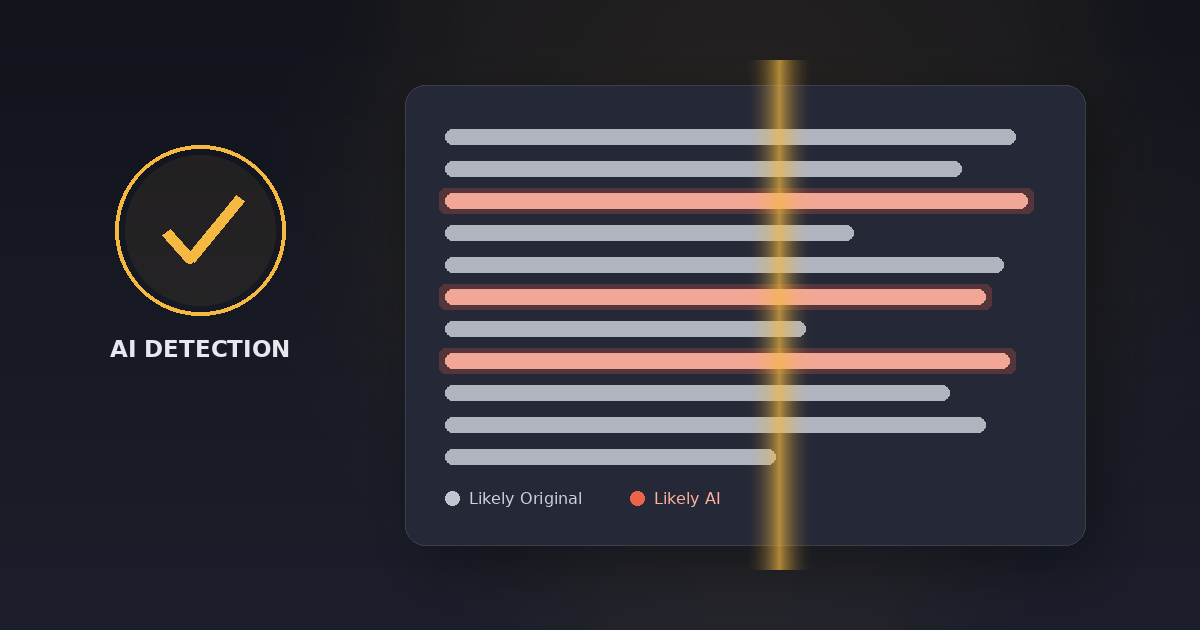
- AI Checker. Scans text and returns a breakdown of Likely AI, Likely Original, and Mixed (AI-edited) writing, with sentence-level highlighting showing which parts triggered the AI score. The detector also flags AI-paraphrased content run through tools like QuillBot, a common way writers try to disguise AI output.
- Plagiarism Checker. Runs alongside the AI check (or on its own) to compare submitted text against existing published content.
- Deep Scan. Shows why specific sentences were flagged as likely AI and suggests edits to make the writing read more naturally, instead of just returning a score with no explanation.
- Content Quality Score, Grammar Checker, Readability Checker, Guideline Checker. Secondary editorial checks that pull from the same credit pool, useful for agencies managing freelance writers at scale.
- Fact & AI Hallucination Checker. Checks factual claims in a document against source material, aimed at catching AI-generated hallucinations before publication.
- Multilingual detection. The current model automatically identifies AI-generated text across more than 30 languages.
- Integrations. Chrome and Firefox browser extensions, a Google Docs add-on with a "Writing Replay" feature showing a document's authorship timeline, a Moodle plugin for schools, and an API for developers running checks at scale.
- Published accuracy data. A blog that publishes a version history of every detection model release with its accuracy and false-positive rate, plus a running list of 18 third-party studies comparing it against GPTZero, Turnitin, Copyleaks, Winston AI, and ZeroGPT — reported accuracy across those studies ranges from 83% to 100%, depending on dataset and methodology.
Pricing (as of October 2026)
Free — $0
One-time allowance, no card required
10,000 words · 100 credits
All tools in limited form
Pro — $14.95/mo
Billed monthly ($12.95/mo annual, save $24/yr)
200,000 words/mo · 2,000 credits/mo
30-day scan history, Deep Scan, Bulk Scan, file upload
Team seats +$8.62–$9.95/mo · Most Popular
Enterprise — $179/mo
Billed monthly ($136.58/mo annual, save $509/yr)
1,500,000 words/mo · 15,000 credits/mo
1-year scan history, API access, priority support
Team seats $19.04–$24.95/mo
Credits are shared across tools: checking 100 words for AI only costs 1 credit, but checking the same words for AI and plagiarism together costs 2 credits. The Free plan's 100 credits are a one-time allotment, not a monthly renewal — once used, continuing requires a paid plan or additional credits (credits bought separately expire after 2 years).
Pros and Cons
Pros
- More independent, third-party accuracy studies back this tool than most AI detectors on the market, and the company publishes its own false-positive rates model by model instead of hiding behind one number.
- Bundles AI detection, plagiarism, grammar, readability, and fact-checking into a single credit pool, cutting down on juggling separate subscriptions.
- Multilingual detection across 30+ languages, with a Chrome/Firefox extension and Google Docs integration for authorship tracking.
- API access and a Moodle plugin make it usable at scale for agencies and schools, not just one writer checking one document.
Cons
- The free plan is a one-time 100-credit allowance, not a recurring monthly quota — meant for a quick first look, not ongoing free use.
- Pricing jumps fast past the Pro tier: beyond 200,000 words a month means paying $179/month (or $136.58/month annually) for Enterprise.
- Third-party accuracy numbers vary a lot by study (83%–100%), so "most accurate" claims should be read against the specific dataset each study used, not taken as a universal guarantee.
- No AI score should be treated as a final verdict on its own — the company itself recommends keeping a human reviewer in the loop.
Who Should Use It / Who Should Skip It
Use it if you're: a content agency or publisher verifying delivered work from freelance writers at volume, an SEO team checking whether content was AI-generated before it ships, a school or individual educator supporting academic integrity with the Moodle plugin or Chrome extension, or a writer or student who wants a Writing Replay record proving their own work is original.
Skip it if you're: someone who wants to run an AI check once in a while with no ongoing need — the one-time free scan already covers that without a subscription — or looking for a tool that promises a single, context-free accuracy percentage as a guarantee; Originality.ai's own transparency about variable third-party results is the more honest way to think about any AI detector's limits.
Final Verdict
Originality.ai backs up its "most accurate AI detector" positioning with more published data than most competitors bother to share — a versioned history of its own models' accuracy and false-positive rates, plus a running list of 18 third-party studies that cover it. That data also shows the honest picture: accuracy across those studies ranges from 83% to 100% depending on the test, which is more useful to know than any single number.
Bottom line: if you're checking content at volume — managing freelance writers, running a content agency, or overseeing a classroom — the Pro plan's 200,000 monthly words is a reasonable starting point, and the credit system scales cleanly into plagiarism and fact-checking without a second subscription. If you just want to check one document today, the free one-time scan is enough.
Frequently Asked Questions
Is Originality.ai accurate at detecting ChatGPT and other AI-generated content?
Originality.ai's current models (5.0 and 5.0 Max, launched October 2026) claim 99%+ accuracy on leading LLMs. Independently, the company's own published list of 18 third-party studies shows accuracy ranging from 83% to 100%, depending on the dataset and testing method — consistently placing it among the top-performing tools when compared against GPTZero, Copyleaks, Turnitin, and Winston AI.
Does Originality.ai detect AI-paraphrased text, like content run through QuillBot?
Yes. The company specifically trains its models on "adversarial data" from tools that rewrite or lightly edit AI text, including QuillBot and some Grammarly rewriting features, to keep paraphrased AI content detectable.
Is there a free plan?
Yes. No card is required, and it includes 10,000 words (100 credits) to test the AI Checker, Plagiarism Checker, and the rest of the toolset. It's a one-time allowance rather than a monthly renewal.
What languages does it support?
The current detection model automatically identifies AI-generated text in more than 30 languages, without needing to set the language manually before scanning.
Should I rely on an AI score alone to make a decision about a piece of writing?
No — and Originality.ai says so itself. The company's guidance is to treat an AI score as one signal among others (writing history, drafts, context) rather than a final, standalone verdict, especially for anything with real consequences like academic discipline or a hiring decision.
Ready to check your content for AI?
Try Originality.ai →AI Tools Hub may earn a commission when you purchase through links on this site, at no extra cost to you. This helps us keep producing free content and reviews.
Keep Reading
Looking for a tool to generate content instead of verifying it? See our Koala AI Review or our Rytr Review. For AI visibility and SEO tools, compare options in our SE Ranking vs Writesonic guide.